
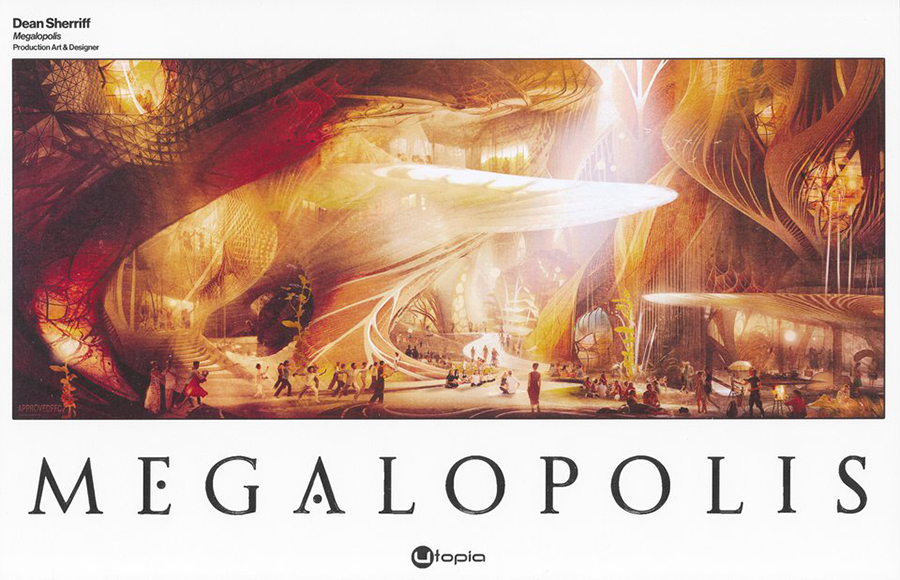

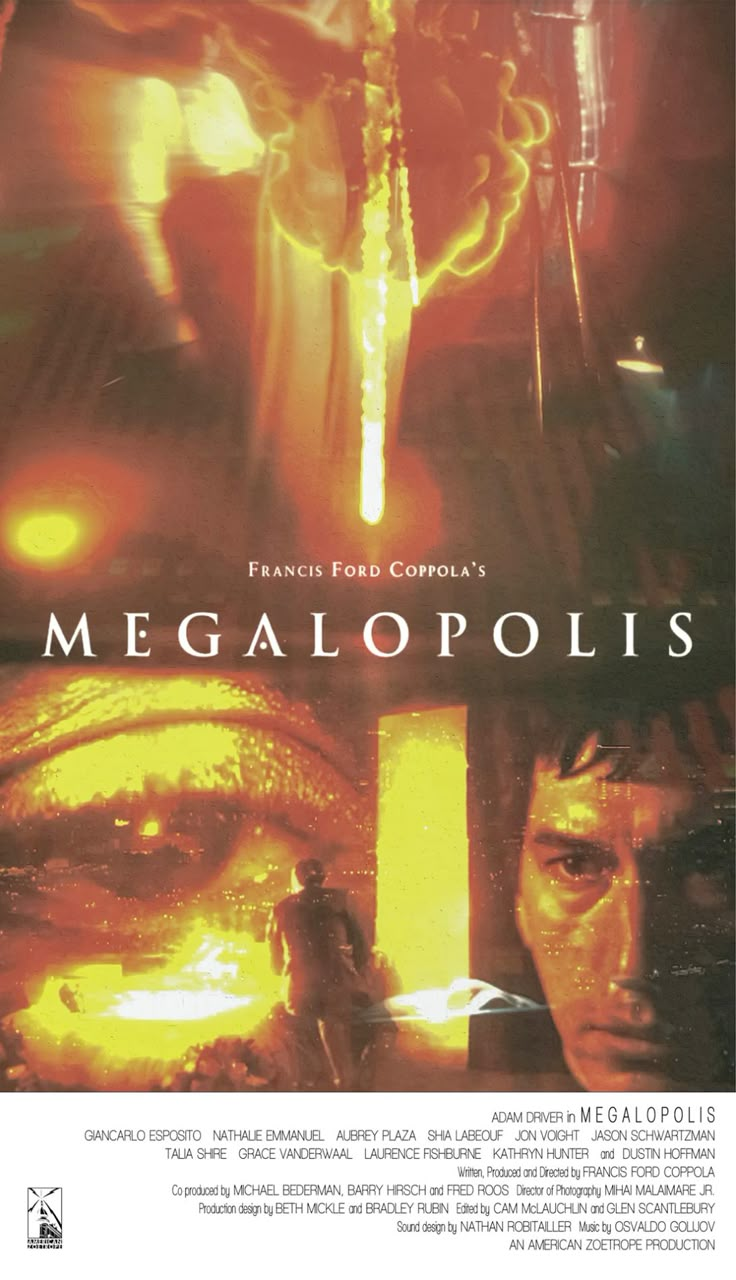
What really intrigued me about Megalopolis was Megalon, the film’s futuristic material: a highly adaptable, mythical substance that promises to rebuild a city. Before I dive into Megalon, here is a brief spoiler-free synopsis to follow along:
Megalopolis presents itself as a Roman epic transplanted to a fictionalized version of New York called “New Rome.” The story follows visionary architect Cesar Catilina, played by Adam Driver, who seeks to rebuild the city as a utopia using Megalon, a revolutionary material he invented.
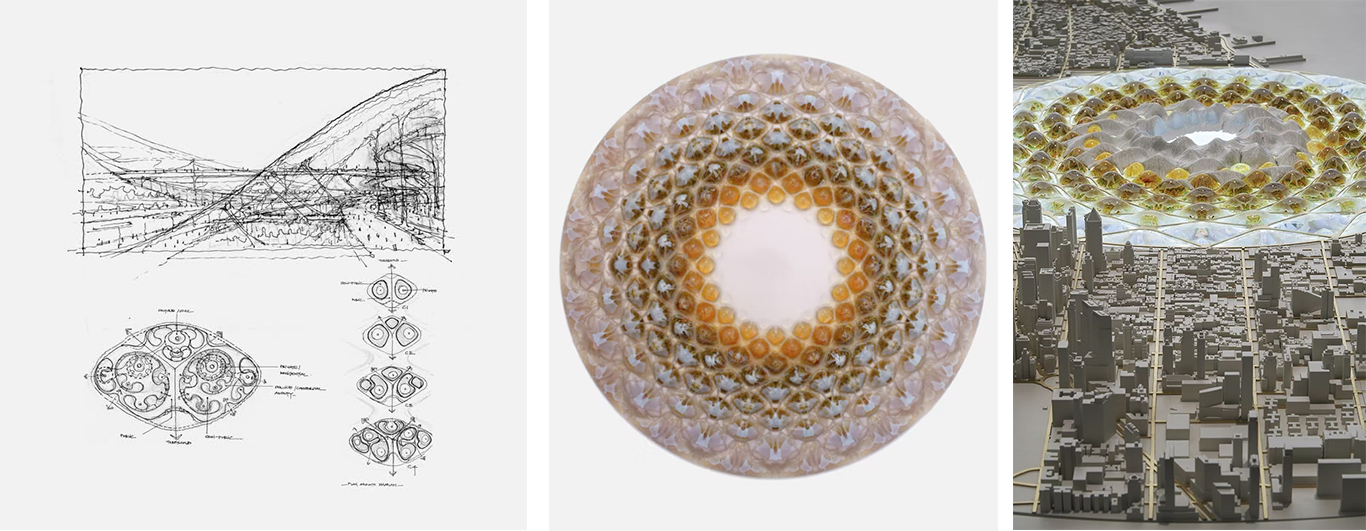
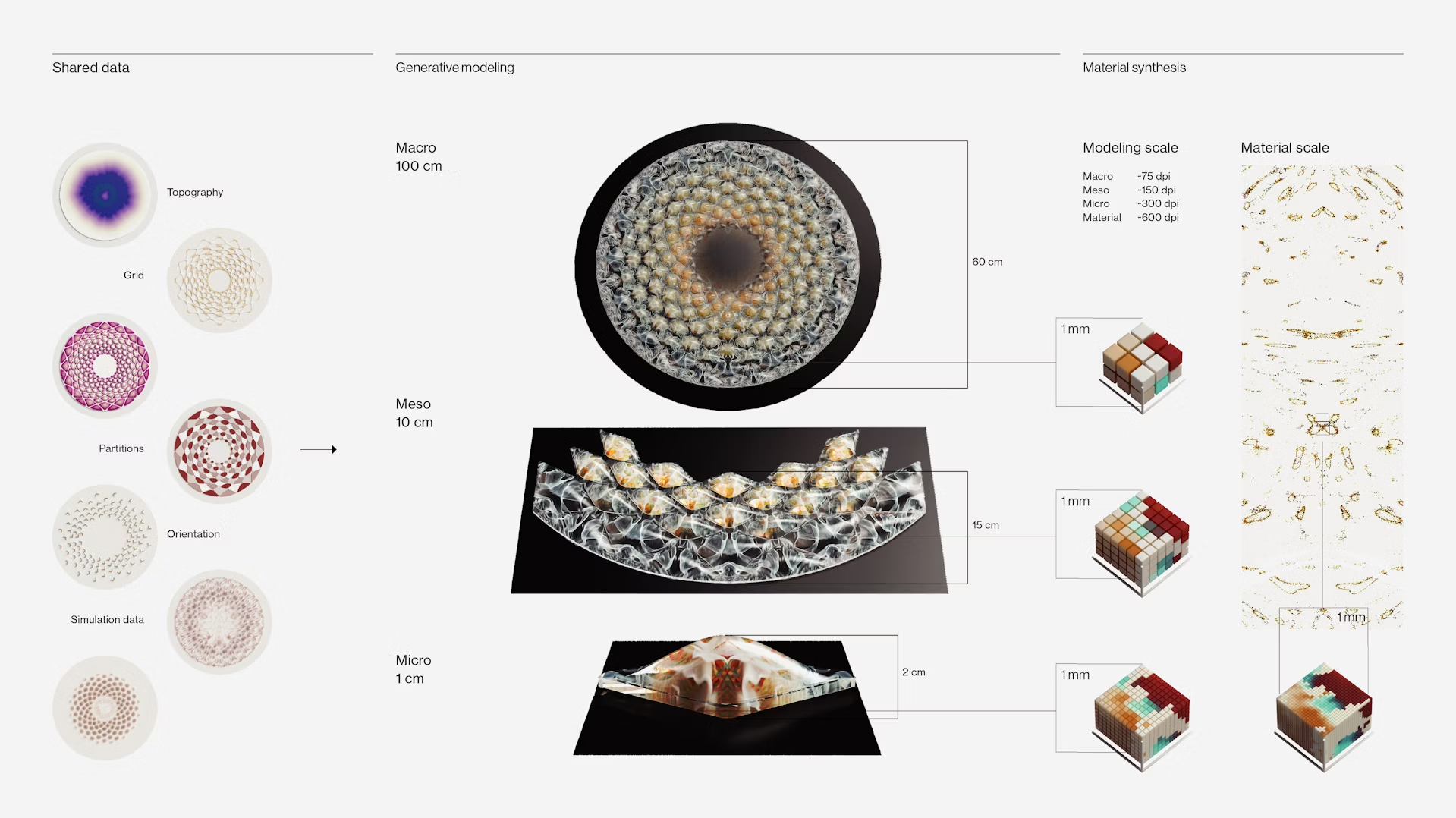
Coppola commissioned a set of studies from OXMAN, the design practice founded by Neri Oxman, to help imagine what Megalon (and the city it enables) could look like. Oxman’s work sits at the intersection of computation, biology, and architecture, and it is often framed around designing with nature rather than simply extracting from it. So the collaboration makes sense for a film in which a new material acts as both a political and architectural force. The resulting project, Man-Nahata, is presented as a series of models and urban studies for Megalopolis.
Neri Oxman is a complicated public figure, but that broader debate is outside the scope of this essay. Here, I want to stay with the work itself.
When I read about Man-Nahata, I must admit I didn’t fully grasp it. I genuinely think Oxman is exceptional at communicating complex ideas to non-expert audiences, but the vision can sometimes feel oversold. The project’s imagery is as beautiful and aesthetic as usual, but it doesn’t really clarify what I’m looking at or how the proposal is meant to operate. Part of that may be on me: I may not know enough about the computational side of the work and seeing the project in person (it was exhibited at MoMA) might also have helped the concept click.
Even when Oxman’s Man‑Nahata studies feel more like an atmosphere than an explanation, they still point to a broader ethos that I recognize from my own field: the idea that future cities will be shaped not only by politics and urban planning, but by materials that can behave, change, and even “perform” in ways we are only beginning to understand.
To name that field clearly: Engineered Living Materials (ELMs) are materials that incorporate living organisms, or are grown and designed with them, so that the material can do things inert matter usually cannot. They can respond to their environment, repair damage, and adapt over time. With that in mind, Megalon starts to feel less like pure metaphor and reads like a cinematic cousin of ELMs.
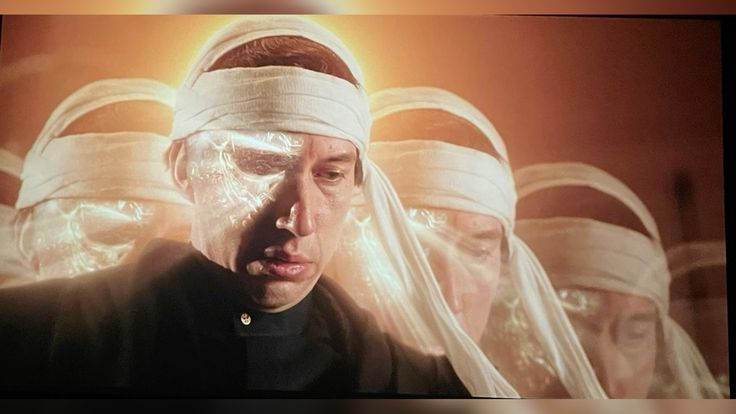
Not everyone is convinced by Megalon. In one review I read, the writer is fine with it staying intentionally vague as a golden dream substance, but loses patience when it suddenly develops into what he calls “insane medical applications.” At one point, Megalon is used to heal Catilina after he is shot, briefly turning part of his face into Megalon before it later returns to normal. I understand the irritation. It’s another moment where the film seems to ask Megalon to be too many things at once.
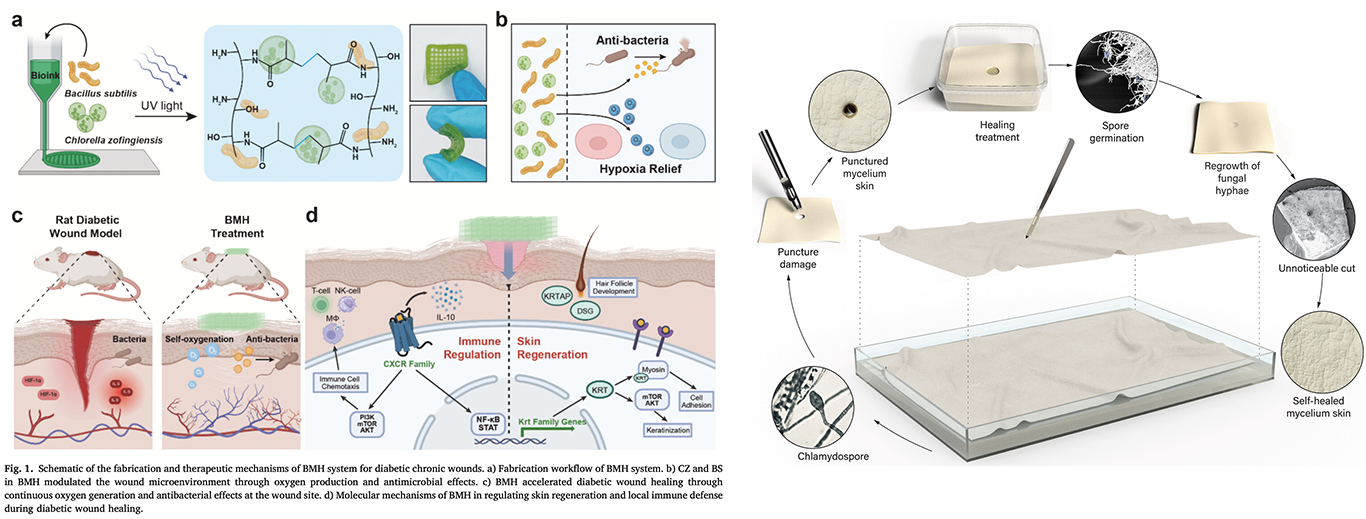
But the underlying impulse is not as surreal as it looks. In the research around me, I see work that already points in that direction. Lin et al. (2026), for example, developed a living wound dressing for diabetic chronic wounds. Their dressing is a 3D-printed hydrogel that hosts two microbes: a photosynthetic microalga and a probiotic bacterium. Under light, the microalgae generate oxygen directly at the wound site, while the bacterial release antimicrobial metabolites. A small, living system designed to both relieve oxygen starvation and suppress pathogens in the same gesture.
Even closer to home, my supervisor prof. Dr. Elise Elsacker works with a different logic: fungal materials that can pause and restart. The material contains dormant spores that can reactivate under plausible conditions. That means the material can recover function after damage, genuinely expressing itself as a self-healing fungal material.
This is the aspect of the film I appreciate most: the fact that Engineered Living Materials, or at least the cultural desire for them, is making it into a Coppola movie. Megalon might be a dream material, but its kind of capabilities are actually beginning to take shape in real research.
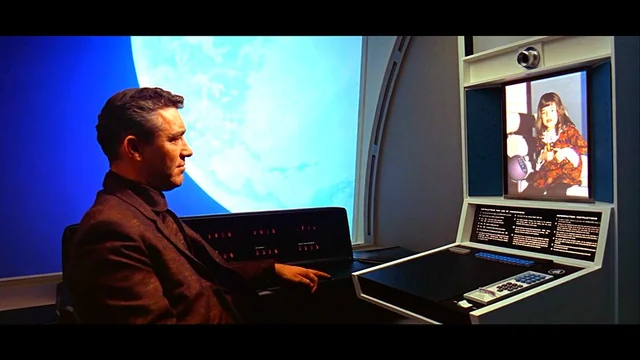
Film is often one of the first places where that kind of innovation becomes culturally imaginable. 2001: A Space Oddyssey, for example, casually depicted video calling through its “Picturephone” in 1968, decades before the technology became part of everyday life. The first widely used video-calling software, CU-SeeMe, was introduced in 1992 (24 years later) and was followed by more familiar examples like Skype in 2003 and FaceTime in 2010.
Lastly, I want to zoom out from the material and say a little more about the film’s protagonist: Cesar Catilina. He is the story’s vehicle for a familiar fantasy: the singular visionary who sees further than anyone else, and whose uncompromising ideas are the engine of progress.
That framing rang a bell for me because last summer I wrestled my way through The Fountainhead by Ayn Rand, after it was recommended to me by a colleague. Once I had finished it, I began recognizing the archetype of its protagonist, Howard Roark, in other characters. One of the clearest echoes was Cesar Catilina in Megalopolis.
A brief, spoiler-free synopsis on The Fountainhead:
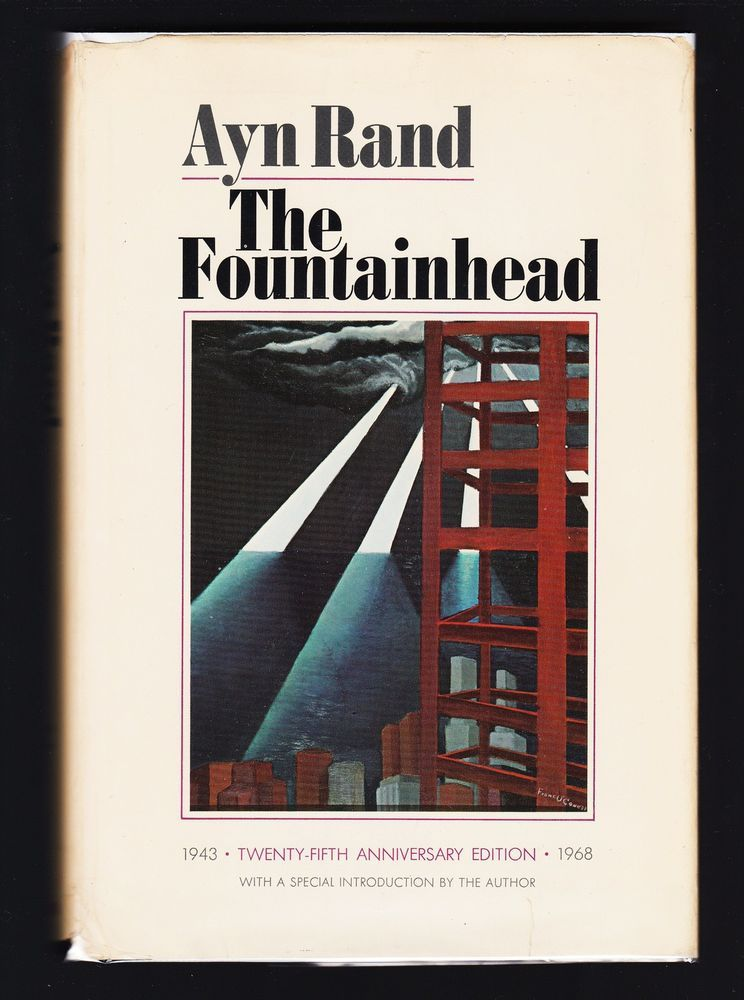
The Fountainhead, a philosophical novel published in 1943, tells the story of Howard Roark, a brilliant and uncompromising young architect who rejects conventional standards in order to pursue his creative vision, even as society demands conformity. The novel expresses many of the ideas that would become central to Rand’s philosophy of Objectivism.
Ayn Rand writes Roark as a particular kind of archetype: the solitary creative genius. An architect whose vision is not just important to him, but higher than compromise, consensus, or public opinion. Roark is Rand’s “ideal man,” shaped by her Objectivist philosophy: pure individualism, rational integrity, and free will.
Catilina isn’t Roark, but he belongs to the same lineage. He is also an architect, also framed as exceptional, also positioned as the one person who can see the city differently (both staged in New York). The difference is that Catilina’s story is presented in more collective language. He is not building only for himself, but “for mankind,” for a better future and a utopian city. But the film still leans on a singular (male) figure who invents the miracle material and becomes the axis around which progress turns.
I loved The Fountainhead. It will stick with me forever. I found truths in it, as well as ideas that I resist. One of the things I continue to push against is exactly this romance of solitude: the idea that the future arrives through one unbothered mind, untouched by other people’s expertise and knowledge.
In reality, such a figure does not exist. The making of Megalopolis itself offers perhaps the clearest contradiction to its heroic narrative. Coppola did not give shape to Megalon alone; he turned to OXMAN’s expertise and sought collaboration to give the material a language and a form. In doing so, the film’s production undermines its own Roark-like ideal: the vision of a singular genius was made possible only through collective knowledge.
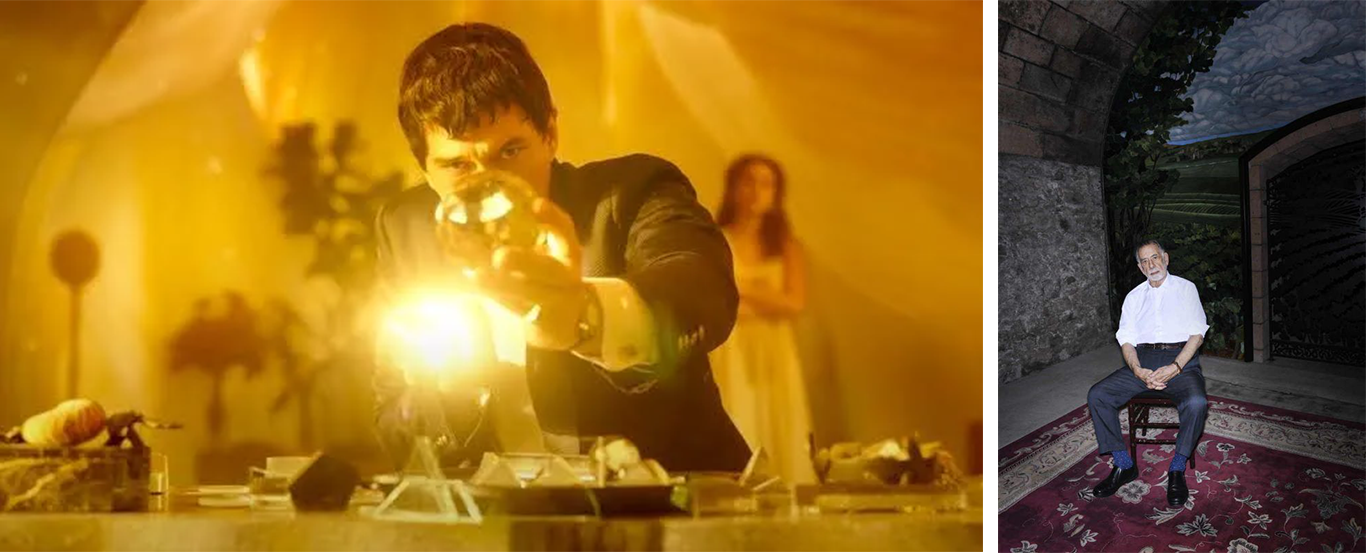
In my own field, that contradiction becomes impossible to ignore. Engineered Living Materials do not allow for the fantasy of the solitary genius. Working with living organisms demands biology. Treating them as materials demands material science. Designing how people will wear them, touch them, trust them, and live with them demands design, ethics, and interaction research. No single discipline is enough, because a living material is never merely a material. It is simultaneously biological, technical, social, and political.
This is where I see the most interesting potential of Megalon. It lies not only in what such a material might make possible, but also in the interdisciplinarity needed to develop it.