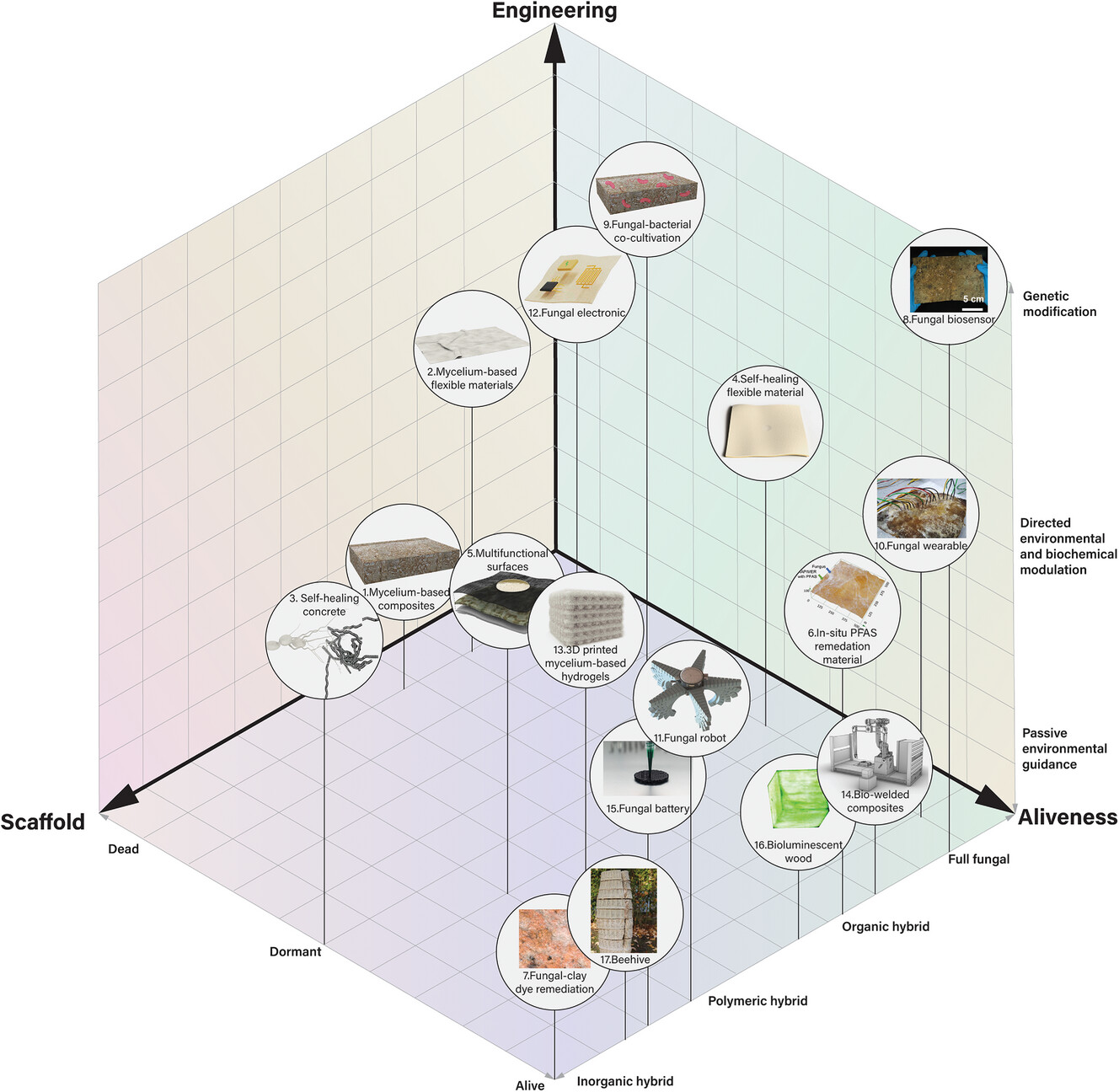
Gradients of Aliveness
“Gradients of Aliveness and Engineering: A Taxonomy of Fungal Engineered Living Materials” is a perspective paper published in Advanced Materials (2026), co-authored within the Microbiology Research Group at VUB (MICR) and funded in part by the European Innovation Council's FUNGATERIA project. With this paper, we are addressing a gap in the field of fungal engineered living materials (ELMs): the absence of a shared framework for classifying materials that vary significantly in biological state, scaffold composition, and degree of engineering intervention.
We propose a taxonomy that maps fungal ELMs across three axes: the spectrum of aliveness, ranging from dead to dormant to living; scaffold composition, from fully fungal to hybrid systems incorporating organic, polymeric, or inorganic substrates; and the degree of engineering, from passive environmental guidance to genetic modification. The paper argues that aliveness in materials should be understood as a gradient rather than a fixed state, with direct implications for how functionality, safety, and end-of-life behaviour are assessed and designed for.
Link to paper